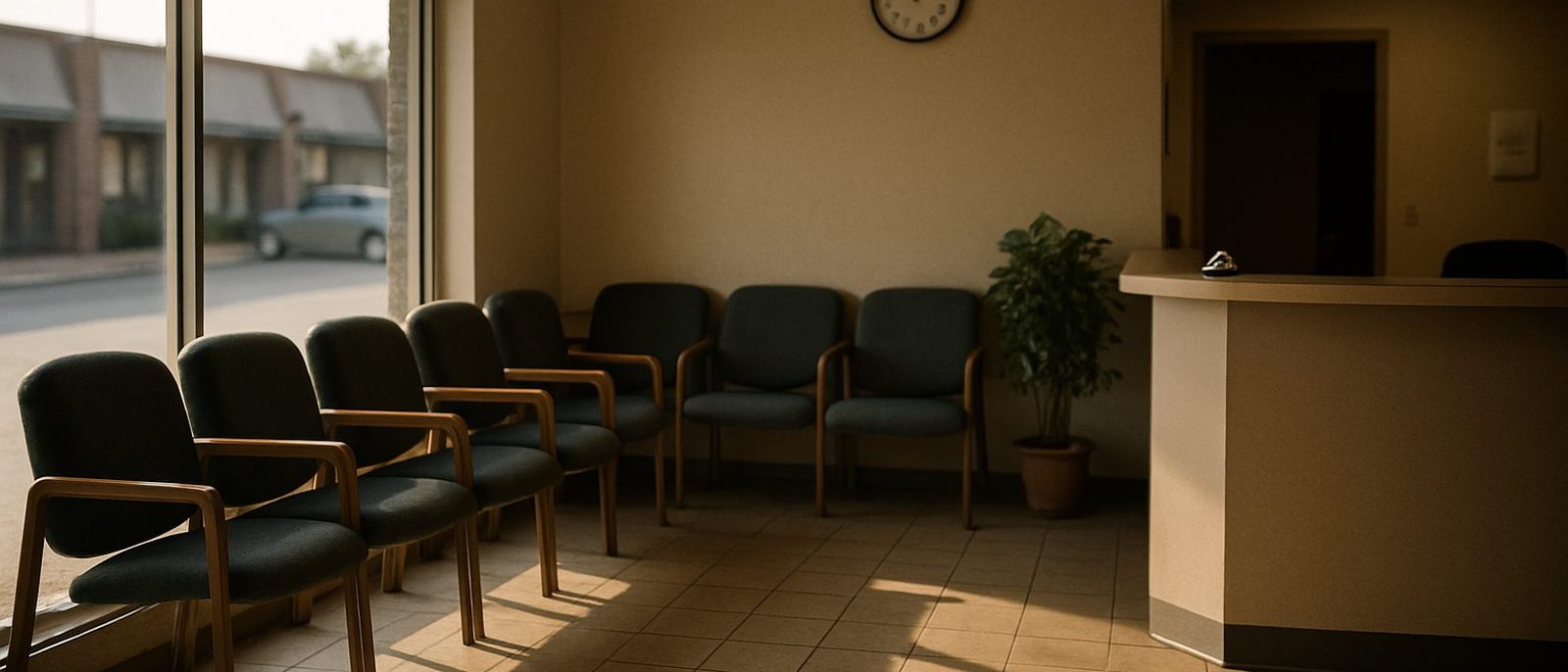
Key takeaways
- Call the nearest office and say the words crash exam. All three offices close from 12 to 2 daily.
- Bring ID, your insurance card, any paperwork from the scene, and a list of what hurts and when it started.
- The visit produces a history, an exam, a diagnosis if supported, and a written plan. Ask for all four by name.
- If you already have an attorney, bring their contact so records can be sent where they need to go. You do not need one to be examined.
- Ask the clinic directly how a visit is billed and what they accept. This desk does not publish payment terms.
There is a version of getting seen after a crash that is mostly waiting: a long phone tree, an intake form that asks nothing useful, and a first appointment that turns out to be a conversation about a second appointment. This page is the other version, the one Missouri Injury Clinic publishes on its own site and the one this desk will hold it to: an exam, findings, and a plan you can read, at whichever of three offices you can drive to this week.
The phone call
Pick the office by the drive, not by the map. Hazelwood at 14 Village Square Shop Ctr serves the north, the airport corridor, and readers coming across the 270 bridge from Illinois. Tesson Ferry at 11144 Tesson Ferry Road, Suite 200, serves south city, south county, and the I-55 and I-44 corridors. O'Fallon at 2163 West Terra Lane serves St. Charles County and the far west. The phones are (314) 627-1411, (314) 530-5480, and (636) 280-0990.
Say the words crash exam. Say when the crash was and what hurts today. If there is a head complaint, headache, fog, light sensitivity, say that too, because the clinic's TBI and concussion lane is a separate set of tools. Ask what they need you to bring. Ask how the visit is billed and what they accept; this desk does not publish payment terms for a clinic it does not own and will not describe an arrangement it cannot verify.
Mind the clock. All three offices close from 12 to 2 every day. Hazelwood and Tesson Ferry run Monday through Thursday 9 to 6 and Friday 9 to 12. O'Fallon runs Monday, Tuesday, and Thursday 9 to 6, with Wednesday and Friday by appointment. Hours are as published on moinjuryclinic.com; confirm on the call.
What to bring
- Photo ID and your insurance card.
- Whatever the scene produced: the exchange of information, the report number, photos on your phone.
- A short written list: what hurts, when it started, what makes it worse, what you have taken for it.
- A list of medications you already take and any prior neck, back, or head injuries.
- If you already have an attorney, their contact, so records can be sent where they need to go.
You do not need to have decided anything about a claim before you get examined. The record is a care document first. It exists so the next clinician works from facts, not memory.
What the visit is supposed to include
The auto injury lane on the clinic's site is defined as diagnosis and a treatment plan after a crash. Unpacked, that is four things.
A history. What happened, from which direction, at roughly what speed, where you were sitting, whether you saw it coming, whether your head hit anything, and what the hours and days since have felt like. Bring the list; the history is better when it is not reconstructed from a bad week's memory.
An exam. Orthopedic and neurological testing: range of motion, palpation, reflexes, strength, sensation, and the specific tests that load the structures a crash loads. This is the part that cannot happen over the phone and cannot happen on a website, including this one.
A diagnosis, if the findings support one. Not a label for the sake of a label. If the findings do not support a diagnosis, a straight answer about that is also a finding.
A written plan. What the treatment is, how often, for roughly how long, what should change and by when, and what would make the clinic send you somewhere else for imaging, a referral, or a different specialty.
Ask them plainly: what did you find, what is the plan, how long before we should expect a change, and what would make you send me somewhere else. A clinician who cannot answer those is not handing you a record worth keeping.
The concussion piece
If the head is part of the story, say so before the exam starts. Missouri Injury Clinic names the tools in its TBI and concussion rehab lane on its own site: vagus nerve stimulation, neurofeedback, Alpha Stim, sensory motor integration, exercise with oxygen, oculomotor rehabilitation, and cognitive rehabilitation software. Whether any of those apply to you is a clinical decision made after the exam, not a menu you order from. What you can do is make sure the fog, the headache, or the screen intolerance is on the list you hand over.
When the answer is not this clinic
An injury clinic is built for planned care. It is not an emergency room and it will not pretend to be one. Chest pain, a sudden severe headache, weakness or numbness on one side, trouble speaking, a loss of bowel or bladder control, or a head injury with vomiting or worsening confusion is an emergency room trip right now. If you call an office and they send you to an ER instead of booking you, that is the system working. The ER-or-clinic guide draws the line in more detail.
What this page is not
Joseph L. Hollingsworth, DC, is a chiropractor. Missouri Injury Clinic is a chiropractic injury clinic, not a law office, and nothing here is legal advice or a comment on anyone's insurance dispute. This desk does not coordinate claims, hold paperwork, arrange payment, or speak to insurers for you. It is a reading desk. It cannot examine anyone and it does not hold anyone's chart.
Chest pain, a sudden severe headache, weakness or numbness on one side, trouble speaking, a loss of bowel or bladder control, or a head injury with vomiting or worsening confusion is an emergency room trip right now, not a call to a clinic.
Advertising disclosure. This page is advertising. This desk is compensated for featuring Missouri Injury Clinic, and it is not the clinic, not a law office, and not a party to anyone's insurance claim. We publish only the lanes, offices, and hours the clinic publishes on moinjuryclinic.com. We do not write reviews, rank providers, or give medical or legal advice.
Educational only, not medical advice and not a diagnosis. Hours and phone numbers are as published on moinjuryclinic.com; confirm on the call.